Frontal Area
Start / Calculations / Chassis Calculations / Frontal Area
The Frontal Area page determines the frontal area of a vehicle, based on:
Frontal height
Frontal width
Frontal area percentage
Measuring Frontal Area
Frontal area is defined as the size of the vehicle as seen from straight ahead. Use this technique to get an accurate measurement for any vehicle:
- Set up the vehicle like it will be driven, including a driver of the right weight and, for motorcycles, size.
- Take a photograph from straight ahead of the vehicle so that most but not all of the picture is filled by the vehicle. Do leave some space at the top and bottom as well as on both sides. Do not cut off any parts of the vehicle. Use at least a 40mm lens to prevent distortion caused by a wide-angle lens. This should not be a problem as long as you stand at least 15 feet (3 meters) from the vehicle.
- Measure the actual height and width of the car.
- Using a large print of the picture you made, draw a rectangle that touches the ground and the top and sides of the vehicle. Divide this rectangle into a grid of evenly sized cells. The more cells you use, the more accurate your measurement will be.
- Count the number of cells in the grid that are half or more filled with the vehicle. Include the area between the vehicle and the road, between the tires. To find the percentage of the rectangle that is filled, divide the number of filled cells by the total number of cells. Then multiply height x width x percentage to get the actual frontal area.
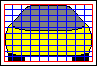
Example: vehicle is 4 feet high and 6 feet wide. A grid of 15 by 20 cells was used, and 200 cells were filled.
Percentage = 200 / (15 X 20) = 200 / 300 = 0.67 (67%)
Area = 4 X 6 X .67 = 24 X .67 = 16 square feet.